

This article provides a comprehensive and in-depth look at yarn dyeing processing techniques, focusing on color fastness control standards – a vital factor in the high-end textile industry. We will analyze everything from color theory to practical testing equipment in the Lab.
1. Yarn Dyeing Processing: Art And Technique In The Textile Industry
Yarn dyeing is the foundation for creating textile products with sophisticated patterns and superior quality compared to regular piece-dyeing. To clearly understand this process, we need to view it from both molecular chemistry and precision mechanical engineering perspectives.
1.1. Physicochemical Nature Of The Yarn Dyeing Processing
Yarn dyeing processing is not just surface contact between liquid and solid, but a chain of thermodynamic diffusion reactions. Initially, dye molecules in the solution perform Brownian thermal motion to adhere to the fiber surface (adsorption stage). However, if it stops here, the color will easily wash away. To achieve high color fastness, dyes need the support of temperature and dyeing auxiliaries to penetrate into the amorphous regions of the fiber structure (diffusion stage).
1.1.1. Mechanism for forming stable chemical bonds
Depending on the nature of the fiber (proteins like silk and wool or cellulose like cotton), chemical bonds will form differently. For cotton fibers in reactive yarn dyeing processing, color molecules create stable covalent bonds with the hydroxyl groups of cellulose through substitution or addition reactions. This is the strongest chemical bond in the dyeing industry, helping fibers withstand the harshest washing conditions without losing their original brightness. Conversely, for polyester fibers, disperse dyes “dissolve” into the solid plastic fiber core under high temperatures above 130°C.
1.1.2. Role of kinetic factors in the dyeing bath
In yarn dyeing processing, parameters such as electrolyte (salt) concentration, solution pH, and dyeing water circulation speed play a key role. Salt helps neutralize the negative charge on the cotton fiber surface, allowing the dye to get closer for reaction. Meanwhile, precise pH control activates the dye’s functional groups at the right time, preventing dye hydrolysis before it can adhere to the fibers, thereby ensuring optimal dyeing efficiency.
1.2. Absolute Advantage Of Fabrics Woven From Dyed Yarn
High-end fashion brands always prioritize yarn dyeing processing because it brings physical properties that piece-dyeing cannot replicate. First is absolute penetration; when yarn is dyed under high pressure in modern dyeing machines, the dye solution is continuously circulated, helping the color go deep into the yarn core. This ensures that when the yarn is stretched during weaving or use, consumers will not see white “yarn feet” or uneven color areas.
Furthermore, yarn dyeing processing is the key to opening a world of diverse patterns. Stripes, checkers, or Jacquard fabrics with sophisticated embossed patterns must use pre-dyed yarn bundles. The sharpness at the intersection points of colors on fabrics woven from dyed yarn is always completely superior to printed or piece-dyed fabrics, creating a luxurious and classy look for the final product.
2. International Standards For Color Fastness
In global trade, the color fastness of yarn after yarn dyeing processing is defined by international numbers and certificates. Compliance with these standards is not only a technical requirement but also a commitment to quality from the manufacturer.
2.1. Global ISO 105 Standard System
ISO 105 is the most powerful set of standards, applied in most European and Asian countries. Among them, the ISO 105-C06 standard focuses on washing color fastness, specifying detailed testing conditions simulating industrial machine washing. Yarn samples after yarn dyeing processing will be placed in steel cups containing steel balls to create mechanical impact, combined with standard detergents without brighteners.
2.1.1. Classification of ISO 105 testing conditions
This set of standards does not have a single method but is divided into many levels from A1S (gentle wash at 40°C) to E2S (harsh wash at 95°C). The choice of testing level depends on the final intended use of the yarn. For example, yarn processed for tablecloths or workwear will have to undergo tests at much higher temperatures than yarn used for delicate evening fashion.
2.1.2. Significance of standard synchronization in the supply chain
Consistency according to ISO 105 helps yarn dyeing processing workshops in Vietnam share a technical language with customers in France, Germany, or Italy. When an order requires “Color Fastness to Wash: Grade 4 (ISO 105-C06)”, all parties involved clearly understand the procedure and the allowable error limits, thereby minimizing commercial disputes related to color quality after production.
2.2. AATCC Standards In The US Market
If ISO is the benchmark in Europe, AATCC (American Association of Textile Chemists and Colorists) is the “rule of the game” in the US market. The AATCC 61 standard is often used by brands like Nike, Adidas, or Gap to evaluate color changes after multiple heavy wash cycles. This process requires absolute precision in preparing color-fixing chemicals in yarn dyeing processing.
2.2.1. Specifics of the Crocking test method (AATCC 8)
Testing friction resistance according to AATCC 8 uses a device called a Crockmeter with specific pressure parameters and number of rubs. The biggest difference is that AATCC emphasizes wet friction resistance heavily, because the US market has very high standards for health safety. Yarn after yarn dyeing processing is not allowed to leave any color stains on the wearer’s body when sweat appears or when it rains.
2.2.2. Differences in evaluation between AATCC and ISO
Although both aim for quality goals, AATCC’s scoring scale and light box sample viewing method have their own rules regarding viewing angles and types of light sources (usually prioritizing D65 and Cool White Fluorescent sources). Understanding this difference helps yarn dyeing processing manufacturers adjust chemical formulas appropriately for each target market.
3. Intensive Washing Fastness Inspection Techniques
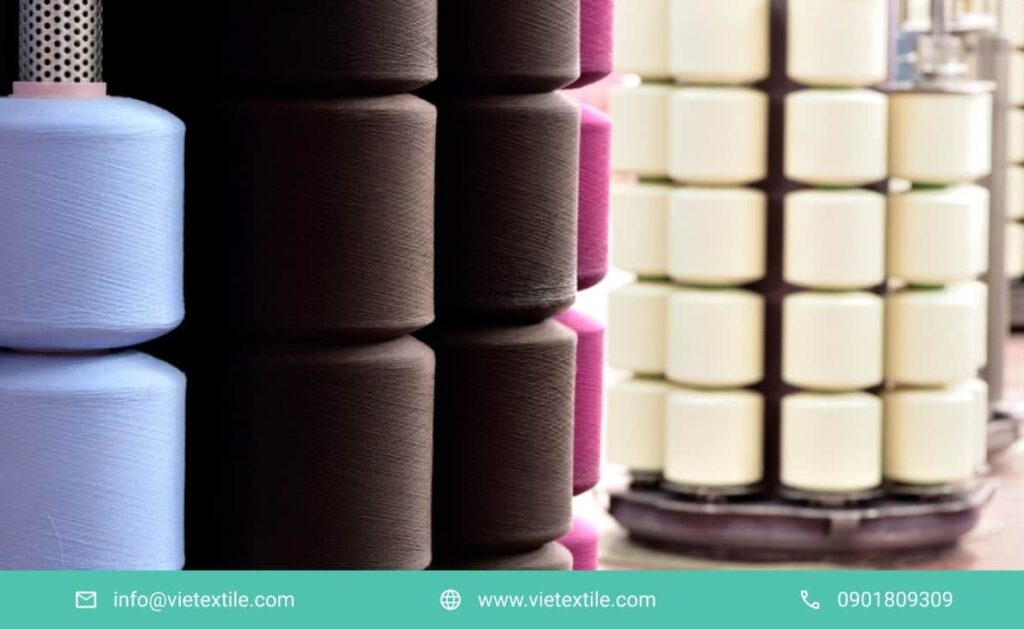
Washing color fastness reflects the dye’s ability to remain in the fibers when facing the effects of temperature, detergents, and mechanical friction in the washing machine.
3.1. Setting Up Tests With Launder-Ometer
The testing process begins with preparing a “sandwich” sample – where the yarn sample after yarn dyeing processing is sewn between a piece of multi-fiber fabric. This multi-fiber fabric contains 6 popular components: acetate, cotton, nylon, polyester, acrylic, and wool. Using multi-fiber fabric helps technicians observe whether the dye tends to stain other types of materials when washed together.
The Launder-Ometer machine will operate at customized temperatures such as 40°C, 60°C, or 95°C. In this environment, if the dye is not well-shaped during yarn dyeing processing, it will easily separate from the fiber due to hydrolysis or chemical bond breakage. Test results will be the most important basis for the workshop to adjust the dyeing formula or strengthen the fixing step if necessary.
3.1.1. Impact of steel balls and mechanical force in the dyeing cup
Stainless steel balls are added to the test cup to create continuous mechanical collisions on the yarn bundle. This simulates the spinning and twisting force of modern front-loading washing machines. If the color layer on the fiber surface after yarn dyeing processing is only loosely attached, this impact force will cause color molecules to peel off and wire to nearby white fibers, causing serious cross-staining.
3.1.2. Analyzing standard detergent components (ECE Detergent)
The detergent used in the Lab is not regular laundry powder but an ECE or AATCC 1993 Standard Reference Detergent mixture. These substances contain specific chemical components without optical bleaches to ensure accurate evaluation of the dye’s actual state. This helps the yarn dyeing processing workshop know exactly whether their dye is resistant to basic chemical agents or not.
3.2. Evaluating Results Using Grey Scale And Spectrophotometer
After the sample has been washed and dried, the most important step is evaluating the degree of color change. The Grey Scale is divided into levels from 1 to 5 with standard contrast pairs. Level 5 corresponds to no color difference between the sample before and after washing, while level 1 denotes severely damaged color. High-quality yarn dyeing processing goods for export usually must reach level 4 or higher.
3.2.1. Automated color measurement by Spectrophotometer
To eliminate errors due to subjectivity and ambient light, VieTextile’s modern Labs use a spectrophotometer. The machine will scan the fiber surface after yarn dyeing processing to analyze L*, a*, b* color coordinate values. From there, the software will calculate the Delta E index (total color deviation) and compare it directly with the original sample. This method provides precise quantitative data down to each color micro-unit.
3.2.2. Controlling light conditions in the color matching cabinet
When evaluated by eye, the yarn sample must be placed in a standard Light Box with sources such as D65 (daylight), TL84 (European store light), or UV. This ensures that the color change after yarn dyeing processing is observed under the strictest conditions, avoiding discrepancies due to “light illusions” (Metamerism).
4. Friction Resistance Testing: A Challenge For Dark Colors
Friction is the most frequent physical impact a textile product must endure. Friction resistance testing helps evaluate the stability of the dye layer on the fiber surface after yarn dyeing processing.
4.1. Dry Friction And Wet Friction: Two Opposite Aspects
In dry friction testing, we evaluate the peeling ability of dye particles due to pure mechanical force. This usually happens when color molecules are too aggregated in the fiber sheath instead of penetrating deep into the core. For regular garment yarns, the dry friction index usually achieves a high score easily if the yarn dyeing processing temperature is well-controlled.
However, wet friction is the real “nightmare” for dark colors like red, navy, or black. When fibers are damp, they (especially natural fibers) will swell, loosening the internal polymer networks. This creates an opportunity for the dye to migrate to the surface and stain other objects. A reputable yarn dyeing processing workshop must handle this issue by using dispersing aids and scouring (reduction clearing) very carefully after dyeing.
4.1.1. Color Migration phenomenon in humid conditions
When cotton fiber comes into contact with water, weak hydrogen bonds between the dye and cellulose can be temporarily broken. If friction occurs at this moment, the dye will “migrate” to the contact material massively. This is the most common error in denim or non-standard hand-dyed yarns. In professional yarn dyeing processing, fixing this phenomenon requires multi-layer color-fixing treatment steps with cationic polymers.
4.1.2. Influence of fiber surface structure on friction resistance
Fibers with fuzzy surfaces or many pills (pilling) usually have poorer friction resistance because colored pills are easily broken and adhere to the test fabric. Therefore, pre-treatment steps such as singeing or mercerization before yarn dyeing processing play an extremely important role in improving the final friction index of the product.
4.2. Strategies To Improve Friction Fastness Index
To solve the friction puzzle for fastidious colors, VieTextile applies Nano technology in the finishing stage. Special resin-based or silicone fixing agents will create an ultra-thin film covering around the fiber. This film acts as a protective “shield,” preventing the movement of the dye when there is a strong rubbing force.
4.2.1. Application of new generation Fixing Agents
Modern fixing agents not only adhere to the surface but also partially penetrate into the fiber sheath to create a cross-linking network. This helps lock free dye molecules remaining after yarn dyeing processing, thereby significantly improving the wet friction score from level 2 to level 3.5 or 4.0 – an extremely difficult standard to achieve for deep black.
4.2.2. Controlling dye residue after the dye bath
By optimizing the dyeing chart and using a high-capacity circulating pump system, we ensure that excess dye does not accumulate on the fiber. The neutralized washing process with mild organic acid after yarn dyeing processing helps completely remove impurities and excess alkali, keeping the fiber surface always clean and chemically stable.
5. Light Fastness: The Durability Of Chemical Bonds
Sunlight, especially ultraviolet (UV) radiation, has extremely large energy enough to break chemical bonds in dye molecules, causing fading of the yarn after yarn dyeing processing.
5.1. Fading Mechanism And UV Simulation Testing
Fading occurs due to photo-oxidation. Under the impact of UV rays, benzene rings and colored double bonds (chromophores) in the dye are destroyed. The artificial light fastness test using Xenon lamps will simulate this condition with an intensity dozens of times higher than reality. This is particularly important for yarn dyeing processing used for curtains, outdoor furniture, or tarpaulins – products exposed directly to harsh sunlight every day.
5.1.1. Analyzing the absorption spectrum of dyes
Each color type has a different “weakness” to the UV wave band. For example, yellow usually fades faster than blue because the chemical structure of yellow dye is easily excited by short-wave rays. In high-end yarn dyeing processing, experts must calculate the mixture of dyes with equivalent light fastness to avoid the phenomenon of color shade change (from orange to pink) when left in the sun.
5.1.2. Influence of relative humidity in the Xenon chamber
The standard Xenon test requires controlling humidity around the sample at about 40-65%. High humidity will soften the fiber structure, allowing free radicals formed from UV rays to attack deeper into the dye. Therefore, the light fastness result in yarn dyeing processing is a composite index between UV resistance and the thermo-humid resistance of the color system.
5.2. Evaluation via Blue Wool Scale
Unlike the grey scale used for washing, the light fastness of yarn after yarn dyeing processing is compared with 8 standard blue wool samples with increasing durability from 1 to 8. The yarn sample after light exposure will be placed next to these blue wool samples to determine the corresponding level. Usually, synthetic fibers like Polyester after yarn dyeing processing can reach level 7-8, while natural fibers like silk usually only reach level 3-4 without protective auxiliaries.
5.2.1. UV Absorber technology
To improve UV resistance for high-end yarn lines, we often add special chemicals directly to the dyeing bath. These substances act as a type of “sunscreen” for the fabric fibers, absorbing UV energy before it can touch the dye. This is an advanced technique that helps pastel (light) yarn dyeing processing still achieve a Blue Wool index of level 6 or higher.
5.2.2. Choosing Metal-complex dyes
For orders requiring permanent light fastness, VieTextile advises customers to use metal-complex dyes. The structure containing a central metal atom helps stabilize the electron cloud of the color molecule, making it extremely stubborn before photochemical agents. This is the optimal solution for automotive interior or outdoor decorative yarn dyeing processing.
6. Color Fastness Testing With Perspiration And Specific Environmental Agents
Fashion products face not only washing or sunlight but also impacts from the wearer’s body through sweat – a complex chemical mixture including salts, amino acids, and enzymes.
6.1. Acidic And Alkaline Perspiration Fastness Testing
Human sweat has a pH that changes depending on body constitution and working environment. In the laboratory, we create artificial sweat solutions with two types: acidic (pH 5.5) and alkaline (pH 8.0). Yarn after yarn dyeing processing will be soaked in this solution and incubated in a Perspirometer at 37°C for 4 hours. This incubation process simulates wearing tight clothing in a hot and humid environment for a long time.
6.1.1. Impact of Histidine on color bonding
The danger of sweat lies in Histidine – an amino acid capable of forming complexes with metals in the dye, changing the color shade. If the yarn dyeing processing formula is not well color-fixed, sweat will partially dissolve the dye and cause staining on nearby fabric areas, creating unsightly blotches on clothes.
6.1.2. Relationship between perspiration fastness and light fastness
An interesting but dangerous phenomenon is “Light & Perspiration Fastness.” When fibers are both stained with sweat and exposed to the sun, the fading rate will be 5 times faster than normal. For yarn dyeing processing orders for outdoor sportswear (such as running shirts, golf), this combined test is mandatory to ensure the product does not change color blotchily after a workout session.
6.2. Fastness To Chlorine Water And Sea Water In Swimwear
For the segment of yarn processed to produce swimwear, the chlorine water color fastness test is mandatory. Chlorine in swimming pools is an extremely strong oxidizing agent, which can “bleach” fabric fibers after just a few uses. To overcome this challenge, swimwear yarn dyeing processing must use special Reactive dyes with stable metal complex structures.
6.2.1. Antioxidant mechanism of swimwear dyes
Common dyes will be attacked by Chlorine at the chromophore groups, breaking the structure and making the color disappear. Anti-Chlorine dyes used in swimwear yarn dyeing processing have special protective groups around the chromophore center, blocking the contact of active Chlorine atoms. As a result, colors remain fresh even after dozens of hours of soaking in the pool.
6.2.2. Testing the impact of sea water salt crystals
Sea water with high salt concentration can swell fibers and create stains when water evaporates leaving crystallized salt. The swimwear yarn dyeing processing at VieTextile includes a surface treatment step with salt-resistant polymer, helping salt particles not to adhere tightly to the fiber and easily be washed away, protecting the original brilliance of the product.
7. Technical Factors Governing Yarn Dyeing Processing Quality
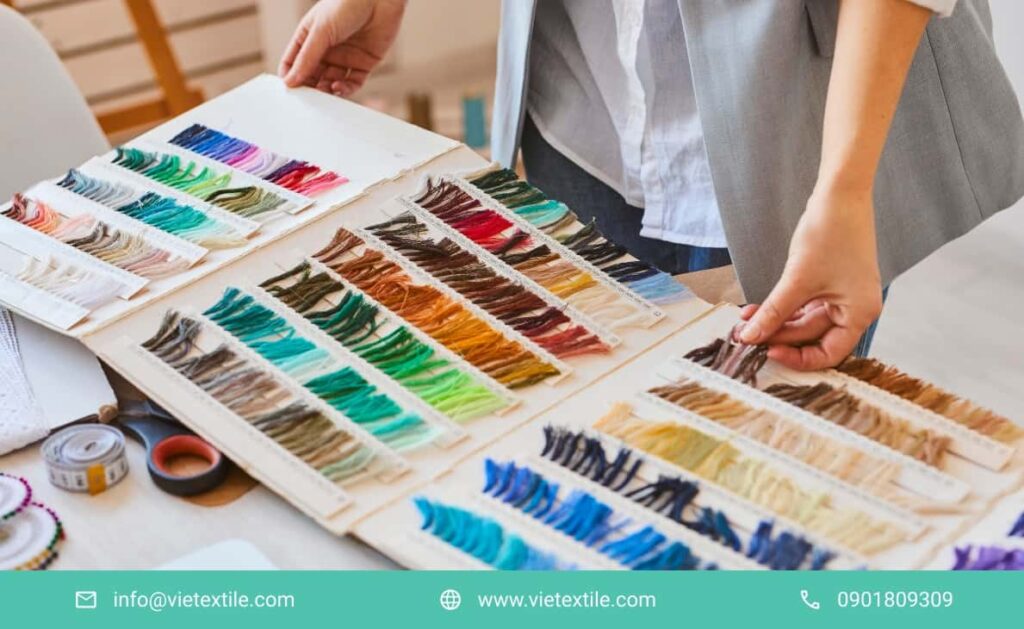
To have a perfect color fastness result, the manufacturer must strictly control every smallest detail in the production chain, from raw materials to machinery technology.
7.1. Pre-treatment: The Foundation Of Color Fastness
A common mistake is focusing only on the dye and forgetting the pre-treatment stage. Greige yarn always contains natural impurities such as waxes, fats, and dirt adhering during the spinning process. If these impurities are not removed through scouring and bleaching, they will create a waterproof film preventing the dye from contacting the yarn core.
7.1.1. Continuous and batch scouring technology
Processing yarn on an unclean fiber base will lead to the phenomenon of the dye color “floating” on the surface, which easily fades when washed or rubbed. At VieTextile, we use environmentally friendly biological scouring chemicals with high penetrating power, helping to remove 99% of fiber wax and create even whiteness for the yarn bundle before dyeing.
7.1.2. Importance of pH neutralization step
Additionally, neutralizing the pH after pre-treatment is extremely important. If the yarn still has residual alkali from the scouring step, it will change the stability of the dye bath, causing uneven or blotchy color. Our automatic pH control system ensures greige yarn is always in a neutral or slightly acidic state – the most ideal environment to start the yarn dyeing processing.
7.2. Pressure Dyeing Technology And Circulating Pump System
In package yarn dyeing processing, the dye solution is pumped through the yarn layers wound on plastic tubes. The success of the dyeing batch lies in the pump flow and pressure.
7.2.1. Controlling pump flow according to yarn winding density
If the pressure is too weak, the color will be dark on the outer layer and fade into the tube core. Conversely, too much pressure can damage the physical structure of the yarn, causing breakage or fuzziness. Our modern dyeing machines are equipped with smart pump speed control inverters, automatically adjusting pressure based on the resistance of the yarn bundle throughout the yarn dyeing processing.
7.2.2. Precise PID temperature chart control
A Rate of Rise that is too fast will cause the dye to adhere to the fiber suddenly and unevenly (color shock phenomenon). Our PID temperature controller allows precise temperature control down to 0.1 degrees Celsius/minute, ensuring the dye migrates gradually and steadily deep into the yarn structure, thereby achieving uniform color fastness for every position in the dye pot.
8. Common Errors And Solutions After Dyeing
Even the most modern factories sometimes face technical errors. What matters is the ability to identify and thoroughly handle them so as not to cause damage to customers.
8.1. Metamerism Error And Root Treatment
Metamerism is a strange phenomenon where two yarn bundles look identical under daylight but become different under neon lights. The main cause lies in mixing incompatible dye combinations in yarn dyeing processing. A yellow-red-blue color set with mismatching light reflection curves will lead to this discrepancy when the light source changes.
8.1.1. Application of Computer Color Matching (CCM) software
To fix this, VieTextile uses CCM software integrated with a huge dye library from famous brands like Huntsman or DyStar. The software will calculate thousands of color combinations and select the formula with the lowest Metamerism Index. This ensures that yarn dyeing processing results have absolute color stability under all lighting conditions.
8.1.2. Multi-light source Lab-dip sample approval process
Before proceeding with mass yarn dyeing processing, Lab-dip samples are always checked in standard light cabinets under at least 3 different light sources (D65, TL84, UV). Only when the sample achieves color consistency under all these light sources do we allow production deployment, ensuring customers always receive the exact shade they expect.
8.2. Bronzing Phenomenon In Dark Colors
This error usually appears as an abnormally shiny metallic film on the fiber surface after yarn dyeing processing of black, navy, or dark red colors. The cause is the dye concentration in the bath exceeding the saturation threshold of the fiber, making the color molecules unable to penetrate inside but crystallize right on the fiber sheath.
8.2.1. Mechanism for forming dye crystallization layers
When the excess dye amount is too large, color particles will bond with each other to form large blocks covering the fiber surface. This “film” not only makes the color look “fake” and negatively shiny but also makes the friction fastness index fall to a disastrous level (grade 1-2).
8.2.2. Special Reduction Clearing technique
Our solution is to perform a multi-stage soaping process at 95°C with strong dispersing agents. Careful washing helps break down excess color crystallizations, returning the most true and deep color. This is the secret that helps VieTextile’s black dyed yarn always achieve Pitch Black while still being soft, not stiff or bronzed.
9. Future Of The Yarn Dyeing Processing Industry: Smart And Green
Under pressure from climate change and social responsibility requirements, the yarn dyeing processing industry is transforming strongly into technologies that consume fewer resources and are environmentally friendly.
9.1. Supercritical CO2 Dyeing Technology: The Pinnacle Of Sustainability
This is a completely “dry dyeing” technology that does not use water. CO2 is compressed to a supercritical state to act as a solvent for the dye. Because CO2 has extremely strong penetrating power, the dye is taken deep into the fiber core in a short time without the need for chemical auxiliaries or salt. Yarn after yarn dyeing processing with CO2 has extremely high color fastness and is completely clean of residual chemicals.
9.1.1. Environmental benefits and wastewater reduction
Traditional dyeing consumes hundreds of liters of water for each kg of yarn. CO2 technology helps reduce 100% of water consumption and 50% of energy. Although the equipment investment cost is very large, this is the direction helping the yarn dyeing processing industry escape the “polluting industry” label and meet the strictest standards of sustainable brands.
9.1.2. Application potential for synthetic fibers
Currently, this technology is proving extremely effective with Polyester and Nylon. Yarn dyeing processing with CO2 not only protects the environment but also keeps the physical properties of the yarn like tensile strength and elasticity intact, as it does not have to undergo scouring processes with strong chemicals like the old method.
9.2. Yarn Digital Dyeing
Instead of soaking the entire yarn bundle in a dye pot, this technology uses microscopic nozzles to dye color directly onto the yarn as it moves at high speed. This technology allows yarn dyeing processing with millions of different colors on the same short section of yarn, creating extremely impressive spatial color effects.
9.2.1. Product personalization and production on demand
The biggest advantage is absolute accuracy and color saving. Only just enough dye is sprayed onto the yarn according to computer calculations, helping to completely eliminate dyeing wastewater. This is a perfect solution for yarn dyeing processing orders with small quantities but requiring high creativity from world fashion designers.
9.2.2. Integrating data and AI in color matching
Digital printing technology allows direct connection from computer designs to the dyeing line. Artificial Intelligence (AI) helps accurately predict color matching on different yarn materials, ensuring yarn after yarn dyeing processing has the exact color as the designer’s 3D drawing, shortening sample development time from weeks to hours.
10. VieTextile – Reputable Yarn Dyeing Processing Partner In Vietnam
With a mindset of always learning and innovating, VieTextile constantly improves production capacity to meet the increasing needs of the global market.
10.1. Commitment To Absolute Quality And Reliability
We understand that every yarn bundle sent out carries the reputation of an entire brand. Therefore, every yarn dyeing processing batch at VieTextile must undergo a rigorous internal quality inspection process. From checking washing color fastness, friction to light fastness, all are recorded and samples kept carefully for 12 months.
10.1.1. 3-layer QC inspection process
At each stage: Pre-treatment – Dyeing – Finishing, the QC team performs sample checking right on the field. This helps detect and prevent technical errors right from when they first arise, ensuring the defective rate in our yarn dyeing processing is always below 1%.
10.1.2. OEKO-TEX safety standard certification
All dyes and auxiliaries used in yarn dyeing processing at VieTextile reach OEKO-TEX Standard 100 certification, ensuring they do not contain carcinogenic or skin-allergenic chemicals. This is a vital factor for customers’ products to penetrate difficult markets like Japan and Northern Europe.
10.2. Fast Color Matching And Flexible Production Service
VieTextile owns a color-matching Lab with modern equipment, allowing for quick Lab-dip samples within 24 hours. We support customers from color ideation, choosing dyes suitable for export standards to mass production with the fastest delivery schedule in the market.
10.2.1. Ability to meet Small Batch Dyeing orders
Unlike large factories that often refuse orders under 100kg, VieTextile has specialized dye pots for samples and small orders (from 5kg – 20kg). This flexible yarn dyeing processing service helps designer fashion brands easily test new collections without pressure on material inventory.
10.2.2. Professional logistics and warehousing system
Located in a convenient position for transport, we provide a full package solution from receiving greige yarn, yarn dyeing processing to packaging and door-to-door delivery. The ERP warehouse management system helps customers easily track order progress and manage their yarn volume most transparently and accurately.
11. Frequently Asked Questions About Yarn Dyeing Processing (FAQ)
11.1. Why Does Red Color Often Fade More Than Other Colors?
Red dye molecules often have a large structure and are difficult to penetrate deep into the yarn core. Furthermore, in yarn dyeing processing, red dyes often have high affinity but bonding is sometimes incomplete if pH is not standard. At VieTextile, we fix this error by extending the reduction clearing time and using specialized fixing agents for warm tones.
11.2. Should Fabric Softener Be Used For Clothes Made From Dyed Yarn?
Fabric softener helps fibers be soft, but some types contain surface-active agents that loosen dye bonds, which may reduce wet friction fastness. For high-end yarn after yarn dyeing processing, we recommend using neutral pH softeners and limiting the use of excessive amounts to protect the color for the longest time.
11.3. Difference Between Yarn Dyeing And Top Dyeing?
Top dyeing is dyeing fibers after combing but before spinning into yarn. Yarn dyeing processing is dyeing after it has become a finished yarn. Top dyeing helps colors blend more naturally (melange color), while yarn dyeing brings more brilliant and uniform colors for woven fabric lines.
11.4. Does VieTextile Support Sending Samples For International Inspection?
Absolutely. We are a regular partner of major inspection organizations such as Intertek, SGS, and Bureau Veritas. Every yarn sample after yarn dyeing processing at the factory can be supported by us to be sealed and sent for inspection at the request of customers to get official export certificates.
11.5. Does Yarn Dyeing Processing Make Yarn Shrink?
The dyeing process under high temperatures can cause a certain shrinkage for natural fibers like Cotton or Viscose. At VieTextile, technicians always calculate this shrinkage before winding tubes to ensure after yarn dyeing processing, the size and elasticity of the yarn still meet the technical parameters requested by the customer.
To receive a quote and in-depth advice on yarn dyeing processing, contact VieTextile’s expert team today!
Contact information:
Hotline: 0901 809 309
Email: info@vietextile.com
Website: https://vietextile.com