

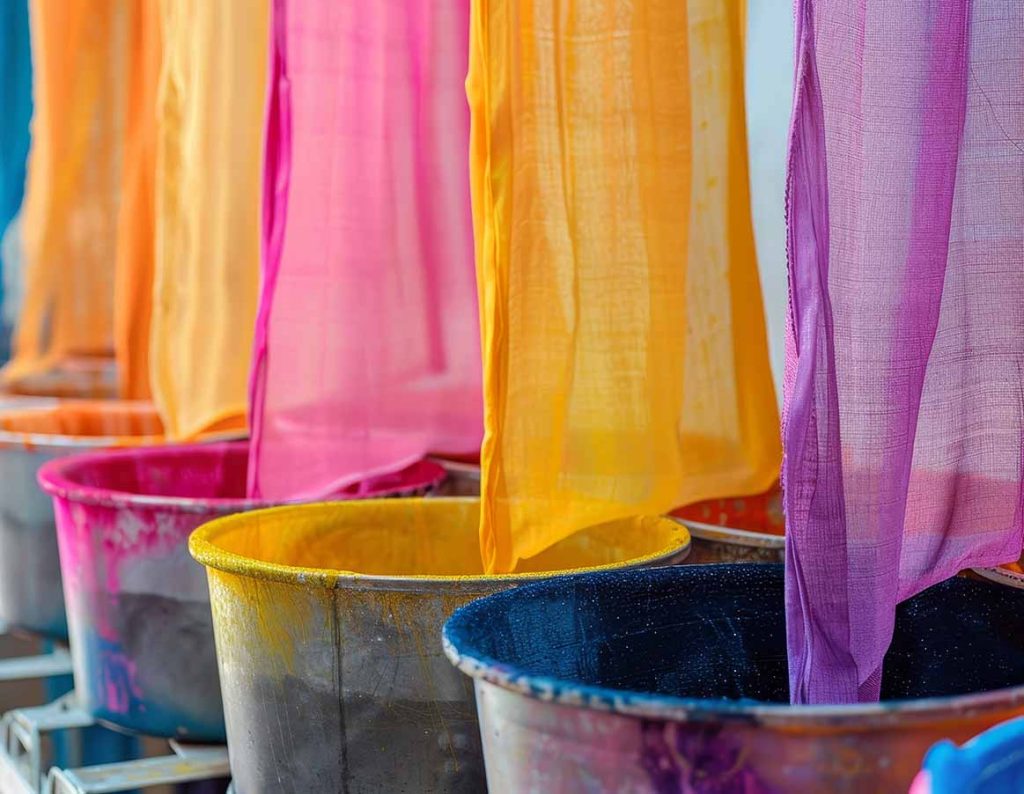
Fabric dyeing is a crucial stage that brings vibrant colors and improves the quality of textile products. Each type of fabric has its own characteristics, requiring specific techniques and dyeing methods. The following article will outline important considerations when dyeing cotton fabric and polyester fabric to help you achieve the best results.
1. Why is it Necessary to Choose the Right Dyeing Method for Each Fabric Type?
Nội dung tóm tắt
ToggleDyeing is the step of applying colors and patterns to fabric to meet customer design requirements. The dyeing process directly affects the quality, colorfastness, and aesthetic appeal of the fabric. Dyeing not only helps cover the natural color of the fibers but can also enhance features such as UV resistance, fire resistance, and antibacterial properties.
To ensure the dyed fabric meets standards and does not fade, become blotchy, or even get damaged, choosing the right dyeing method for each fabric type is extremely important. Each fabric has its own characteristics regarding fiber structure, dye absorption, and colorfastness. For example, cotton has an open, flexible fiber structure that easily absorbs water, while polyester fibers have a closed, smooth structure with fewer gaps. If the wrong dyeing method is chosen, the fabric can be damaged, easily torn, have poor color, and fade quickly with use.
2. Considerations When Dyeing Cotton Fabric
Cotton fabric is made from natural cotton fibers or a blend of cotton with some other synthetic fibers. When dyeing cotton fabric, you should consider the following:
2.1. Prepare the Fabric Before Dyeing
Before dyeing, cotton fabric needs to be scoured to remove impurities like grease, dirt, or sizing. This ensures that the dye can penetrate the fibers evenly, helping the color to be uniformly distributed and long-lasting.
2.2. Choose the Right Dyes for Cotton
Cotton fabric has the ability to absorb water, but its ability to bond with dyes is not very good. This is because the surface of the cotton fiber has a negative electrical charge that does not easily react with dyes. Even when salt and alkali are added to the dyeing solution, the dye only bonds with the cotton fabric at a rate of about 75%. Many types of dyes can be used for cotton, including reactive dyes, direct dyes, and natural dyes. Among these, reactive dyes are often preferred for their ability to create durable, vibrant colors.
2.3. Control Dyeing Temperature and Time
The right temperature and time will ensure the color does not bleed and the fabric is not damaged. Typically, cotton is dyed at a temperature of about 60 – 80°C. A temperature that is too high can damage the fibers, while a temperature that is too low can lead to uneven and easily faded colors.
2.4. Wash and Soften After Dyeing
The cotton fabric needs to be washed to remove excess dye and any residual chemicals. Using a fabric softener after dyeing will keep the fabric soft and comfortable to use.
2.5. Test Before Full-Scale Dyeing
It is essential to test the color on a small fabric sample before dyeing a large batch. This will ensure that the dyeing results are as expected and that no errors occur.
3. Considerations When Dyeing Polyester Fabric
Polyester fabric is a synthetic fabric made from polyester fibers. It is a man-made polymer composed of ethylene derived from coal and petroleum. Before dyeing polyester fabric, you should consider the following:
3.1. Prepare the Fabric Before Dyeing
Similar to cotton, polyester fabric also needs to be cleaned before dyeing to remove impurities.
3.2. Choose the Right Dyes for Polyester
Polyester has a fiber structure that is more difficult to penetrate with dye compared to cotton. Therefore, it is suitable for special dyes designed for polyester such as disperse dyes. Disperse dyes have the ability to penetrate the polyester fibers and create bright, long-lasting colors.
3.3. Control Dyeing Temperature and Time
Dyeing polyester fabric usually requires a higher temperature than cotton, typically around 125 – 130°C. Precise control of the temperature and dyeing time will help the disperse dye spread evenly. Additionally, the pH value of the dyeing solution should be controlled within a weakly acidic range of 5-6.
3.4. Wash and Soften After Dyeing
After the dyeing process, polyester fabric needs to be cleaned to remove excess dye and any residual chemicals. You can move on to the industrial washing stage, or use a suitable fabric softener to make the fabric softer and more comfortable to use.
3.5. Test Before Full-Scale Dyeing
It is necessary to test on a small fabric sample before dyeing a large batch. This ensures that the dye will yield the expected results and will not harm the fabric.
4. Comparing the Dyeing Processes for Cotton and Polyester
You can see the differences between the dyeing cotton fabric and dyeing polyester fabric processes through the following detailed information:
4.1. Cotton dyeing
- Temperature: Warm temperature
- Dyeing time: Soaking time in the color tank for 5-7 days
- Dye fixation capacity: 75%, requires a large amount of salt and alkali for dye bonding
- Dye washing: The process consumes energy and water. Uses many tanks, at least once at boiling temperature
4.2. Polyester dyeing
- Temperature: High temperature
- Dyeing time: Short processing time from 30-60 minutes of heat-retaining dyeing
- Dye fixation capacity: 99% or more, does not require dye fixation agent
- Dye washing: Less energy, water and chemical consumption than cotton dyeing. Uses alkali and chemical reducing agent
4.3. Technical Requirements
- Ensure Accurate Dyeing Results: Adhering to the correct dyeing process and quality control is essential for the desired results. Using the right type of dye, temperature, and dyeing time helps ensure the color is even and does not fade quickly.
- Protect Fabric Properties: Following usage instructions helps protect the mechanical and chemical properties of the fabric. Dyeing at the appropriate temperature and time helps avoid shrinkage, deformation, or damage to the fabric.
- Ensure User Safety: Make sure that chemical residues after the dyeing process are completely removed to ensure the safety of the fabric user.
- Optimize Costs and Resources: Careful calculation and adherence to instructions will help optimize the use of dyes and energy, thereby reducing production costs. This is especially important for industrial models.
- Ensure Consistent Quality: In mass production, following instructions and quality control ensures that all products meet high-quality standards. This builds brand reputation and customer satisfaction.
5. Fabric Dyeing Consultation
Understanding and correctly applying these considerations when dyeing cotton fabric and polyester fabric is important to ensure the quality of textile products. By following the processes and implementing strict quality control, manufacturers can optimize production efficiency and bring customer satisfaction.
If you are looking for an advanced scouring chemical that supports the dyeing process for both cotton and polyester fabrics, don’t miss VieChemol SR – an optimal solution for the scouring and dyeing process. It helps save costs, improve efficiency, and protect the environment. Contact VieTextile today for a consultation and trial:
- Phone: +84 (0) 901809309
- Email: info@vietextile.com
- Office: 82C Quach Dinh Bao, Phu Thanh Ward, Tan Phu District, Ho Chi Minh City