



In the knitwear manufacturing industry, maintaining the original shape of a product after water treatment is a major challenge. The knit wash form retention technique using enzymes is the key to creating garments that are both soft and dimensionally stable.

1. The Nature Of Knitted Fabric And Challenges In Shape Retention
To understand why knit wash form retention is difficult, we need to consider the unique structure of this fabric. Unlike woven fabrics with tightly interlaced warp and weft yarns, knitted fabrics are formed from interconnected loops of yarn, creating large gaps and high elasticity.
This very flexibility makes knit fabric prone to excessive “relaxation” when exposed to water and heat. The yarn loops tend to shift from their original positions, leading to fabric twisting (spirality), hem sagging, or deformation at stress points like knees and elbows.
1.1. Internal Stress And Relaxation Shrinkage
During the knitting and dyeing process, the yarn is continuously stretched by the mechanical parts of the knitting machine. When introduced into the knit wash form retention process, water acts as a lubricant, allowing the yarns to release residual stress and return to their natural shortened state.
Without Enzyme processing to stabilize the structure, this shrinkage occurs randomly and unevenly. This creates wavy wrinkles or completely changes the garment’s size specifications (spec), making the product no longer meet the original design size standards.
1.2. The Problem Of Spirality In Knitted Fabrics
Spirality is the “obsession” of knitwear manufacturers. Due to the twist direction of the yarn (S-twist or Z-twist), the knit loops tend to tilt to one side. When subjected to strong impact in the washing drum, this tendency is strongly stimulated, causing the side seams to push forward.
The knit wash form retention technique requires neutralizing or minimizing this twisting force. Cellulase enzymes help soften the joints between yarn loops, allowing them to self-adjust to an equilibrium state without shifting in the direction of the yarn twist, thereby keeping the pant legs straight and balanced.
2. Mechanism Of Enzyme In Knit Wash Form Retention
Enzymes do not act like regular detergent chemicals but act as biological catalysts. In the knit wash form retention process, Cellulase enzymes attack surface cotton fibers and weak cellulose bonds, helping to relieve stress for the knitted structure.
Removing excess fuzz not only makes the fabric smoother but also helps the yarn loops “slide” over each other more easily to find the most stable position. This is the most important prerequisite for achieving sustainable shape retention effects through many washes.
2.1. Bio-polishing Process And Surface Stability
Bio-polishing is a step using enzymes to “polish” the fabric surface by decomposing micro-fibrils. When these micro-fibrils disappear, friction between yarn loops is reduced, giving the knit fabric a natural drape and preventing it from being “locked” in deformed positions.
2.1.1. Anti-pilling Effect
Pilling is not only aesthetically unpleasing but also makes the fabric heavier and accumulates moisture, putting pressure on the shape. Knit wash form retention through Enzyme processing keeps the fabric surface smooth, thereby reducing unnecessary excess weight and keeping the garment sharp as new.
2.1.2. Enhancing The Clarity Of The Knit Structure
When there is no longer fuzz covering them, the knit loops appear clearer and more organized. This helps the eye perceive the garment shape as sturdier and more high-end, while also making the fabric breathable, reducing stickiness to the skin when the wearer moves.
2.2. Controlling The Elasticity Of Spandex Fibers
Most Denim Knit fabrics contain a high percentage of Spandex for comfort. Enzymes in the knit wash form retention process help clean impurities clinging around Spandex fibers, allowing the elastic fibers to move freely and recover their original state most effectively after being stretched.
2.2.1. Protecting The “Memory” Of Elastic Fibers
Spandex fibers have a “memory” of shape, but high temperatures and harsh chemicals can damage this feature. Using enzymes allows the wash process to take place at lower temperatures, protecting the internal elastic core from becoming brittle, helping the knit wash form retention and preventing sagging in the seat or knee areas.
2.2.2. Synchronizing Shrinkage Between Cotton And Spandex
Cotton and Spandex have different shrinkage rates. Enzymes act as a coordinator, helping these two types of fibers interact more harmoniously in the knitted structure. The result is that the fabric does not suffer from the “orange peel” effect (puckered fabric surface due to elastic fibers shrinking more strongly than cotton fibers) after washing.
3. Specialized Enzymes For Knit Wash Form Retention

Not all enzymes provide the same shape retention efficiency. Choosing between acid enzymes, neutral enzymes, or new-generation enzymes depends on the aesthetic goals and durability requirements of each specific knit fabric.
At VieTextile, we always test thoroughly to select the most suitable enzyme line for each partner’s item. The ultimate goal is always knit wash form retention while still achieving the softness and abrasion effects required by the design.
3.1. Neutral Cellulase (Neutral Enzyme)
This is the “gold standard” in the knit wash form retention process. Operating at a pH of 6.0 to 8.0, neutral enzymes have a gentle impact, focusing only on surface fibers without penetrating deep to weaken the core fiber structure, helping to maintain the strength of the knitted fabric.
3.1.1. Advantages In Maintaining Size Specifications
Because it does not harm the fiber core, knit fabric treated with neutral enzymes has extremely high dimensional stability. The post-wash shrinkage rate is usually very low and consistent, making the mass production process easier to control size specifications compared to using acid enzymes.
3.1.2. Minimizing Seam Slippage
Knitted fabrics are often weak at needle puncture sites. Neutral enzymes protect these joints from excessive wear in the washing drum, preventing seam slippage or pin-holes—factors that indirectly ruin the shape of knit garments.
3.2. New Generation Enzymes (Cold-Water Enzymes)
The current trend is to use enzymes that can operate at room temperature. Eliminating the thermal shock factor in the wash process is a breakthrough that helps knit wash form retention absolutely, as temperature is the number one enemy of the knit loop structure.
3.2.1. Saving Energy And Protecting Fabric Fibers
Cold washing is not only eco-friendly but also keeps cotton fibers from over-swelling. When the yarn is not abruptly transformed by heat, the knitted structure maintains its natural fluffiness, creating a plump and full shape for the product.
3.2.2. Extremely High Reaction Control
Cold enzymes usually have a more stable and predictable reaction rate. This allows technicians to stop the process at the “golden moment,” ensuring the abrasion effect is just enough to be beautiful while still keeping the knit fabric at the necessary stiffness for knit wash form retention.
4. Machine Operation Process For Knit Wash Form Retention
Machinery and operation contribute 50% to the success of shape retention. For knit fabrics, the washing drum is not just a container for chemicals but a controlled environment for physical forces acting on the sensitive knit loop structure.
To achieve knit wash form retention, VieTextile applies machine operation parameters completely different from woven denim. Gentleness and regularity are top priorities to avoid “stressing” the knitted yarns throughout the long processing cycle.
4.1. Adjusting Revolutions Per Minute (RPM) Appropriately
An excessively high rotation speed will create large centrifugal force, stretching the fabric vertically. Conversely, a speed that is too low will cause the fabric to be compressed and stacked at the bottom of the drum. To knit wash form retention, the RPM needs to be calculated based on the drum diameter so the fabric is always in a gentle “free fall” state.
4.1.1. Optimizing Drum Reversal Direction
The drum must be set to reverse direction continuously with short rest periods in between. This prevents the knit fabric from tangling into knots, minimizing localized tension at a single point, thereby effectively preventing spirality and elongation of the product after washing.
4.1.2. Controlling Centrifugal Force During Extraction
The water extraction step after knit wash form retention is extremely important. The extraction speed should be increased gradually from low to high to let water drain slowly. If high-speed extraction is sudden, the pressure of exiting water can displace yarn loops, creating permanent wrinkles that cannot be ironed flat.
4.2. Managing The Liquor Ratio
The liquor ratio in knit wash form retention is usually higher than for regular denim (about 1:8 to 1:12). Abundant water acts as a cushioning layer, helping knit products glide gently in the machine without hitting the drum walls hard.
4.2.1. More Even Enzyme Distribution
When there is enough water, enzymes will be dissolved and contact every surface of the garment evenly. This avoids areas of strong bleaching and weak bleaching, helping shrinkage occur synchronously across the entire product, ensuring knit wash form retention and balance.
4.2.2. Minimizing Surface Friction
Water reduces friction between fabric and fabric, preventing the formation of light-colored streaks due to uneven physical abrasion. This keeps the knit fabric surface thickness consistent, supporting the maintenance of a sturdy shape for details like collars and cuffs.
5. Drying And Finishing Techniques – Final Steps For Shape Retention
More deformation errors occur in the drying stage than in the washing stage. Over-drying or drying at excessively high temperatures will “kill” the elastic fibers and cause extreme cotton shrinkage. Knit wash form retention requires a drying process sophisticatedly programmed according to different temperature stages.
Allowing the fabric to “rest” after drying is equally important. A knitted product after leaving the hot dryer needs to be hung flat so that the fiber molecules can stabilize their positions before packaging, helping the shape to be formed naturally and sustainably.
5.1. Moisture Sensing Technology
Modern dryers will automatically stop when the fabric reaches the ideal moisture level (usually 5-7%). Maintaining a small amount of natural moisture inside the fiber core is the secret to knit wash form retention, helping the fabric not become brittle and maintaining vibrant elasticity.
5.1.1. Avoiding Over-drying
When over-dried, cotton fibers become stiff and lose their recovery ability. The knitted product at this time will be maximally shrunk and cannot stretch flexibly as at the beginning. Controlling moisture helps knit wash form retention and the hand-feel is always soft and fluffy.
5.1.2. Cooling Phase Process
At the end of the drying cycle, the machine should run in cool air mode for 5-10 minutes. This cooling step helps “lock” the yarn loop structure in the most stable state. This is an indispensable finishing technique to ensure knit wash form retention when the product is taken out of the dryer.
5.2. Using Fixing Agents
In some cases where the knitted fabric is too loose, technicians can add low-concentration resins in the final step of the knit wash form retention process. These substances create an ultra-thin film around the fibers, increasing crispness and shape recovery after wearing.
5.2.1. Enhancing Wrinkle Resistance
Fixing agents combined with enzymes help knit fabric wrinkle less after home washing. This helps the garment always maintain an orderly, professional look, especially important for high-end knit polo shirts or knitted trousers.
5.2.2. Open-end Stability
For raw edge designs, fixing agents help the yarn loops not slip out. Combined with knit wash form retention, this technique brings a modern, edgy look without worrying about the product being damaged after long-term use.
6. Advantages Of Choosing VieTextile For Knit Wash Form Retention
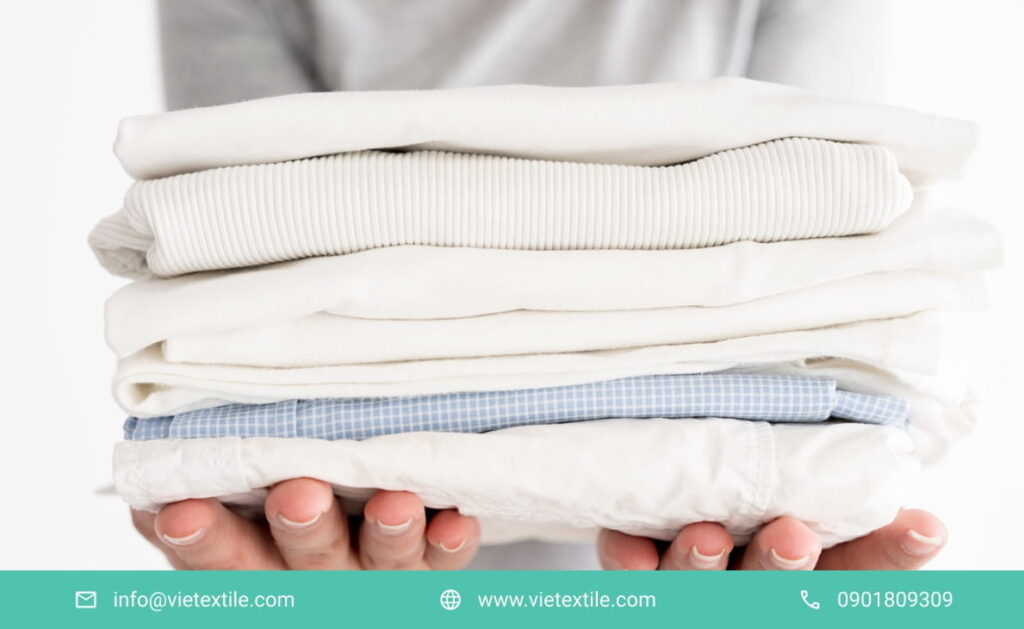
At VieTextile, we take pride in possessing exclusive technological secrets in processing the most demanding Denim Knit lines. We understand that knit wash form retention is not just a technical process but a deep understanding of the interaction between fabric fibers and external factors.
6.1. Shrinkage Testing Lab For Accurate Ratios
Before mass production, every fabric batch at VieTextile must undergo a test wash step to determine the precise vertical and horizontal shrinkage ratio down to 0.1%. This helps our customers’ pattern design department adjust drawings in time, ensuring knit wash form retention of absolute size after mass production.
We provide detailed reports on dimensional stability and colorfastness after 5-10 home washes. This dedication helps customers have complete peace of mind about the final product quality, minimizing consumer complaints about deformed or lost-shape clothing.
6.2. Application Of Premium Biological Enzymes
VieTextile is committed to using only enzyme lines from the world’s leading suppliers (such as Novozymes). These enzymes have high activity and good selectivity, helping the knit wash form retention process reach optimal efficiency in the shortest time, comprehensively protecting the fiber structure.
Using biological enzymes also ensures your products meet green standards (Eco-friendly). In the context of consumers becoming increasingly concerned about the environment, a knit wash form retention product that is also eco-friendly will be a big plus for your brand.
7. Frequently Asked Questions (FAQ)
7.1. Why does my denim knit pant often elongate after washing?
This is the phenomenon of fabric “sagging” due to excessively strong extraction force or improper drying that damages the Spandex fibers. To knit wash form retention, it is necessary to readjust the low-heat drying process and use neutral enzymes to protect the internal elastic core of the yarn.
7.2. Does Enzyme processing reduce the durability of knitted fabric?
If the correct type of neutral enzyme is used and the pH is strictly controlled, the durability of the knit fabric does not decrease but rather increases due to the removal of friction-causing fuzz. Knit wash form retention through Enzyme processing is actually a process of cleaning and stabilizing the sustainable fiber structure.
7.3. Do I need to make the pattern larger to compensate for wash shrinkage?
Definitely yes. All types of knitted fabrics shrink after washing. However, when applying the knit wash form retention process at VieTextile, the shrinkage will be stable and predictable, helping you calculate the shrinkage allowance most accurately.
7.4. How to distinguish between good and poor knit wash shape retention?
A product with good shape retention will have vertical side seams, the hem will not be curling, and when the fabric is stretched, it will recover immediately without leaving marks. The surface of a knit wash form retention fabric always has a certain crispness instead of feeling loose and sagging.
To elevate your products with knit wash form retention techniques, contact VieTextile experts today!
Contact information:
Hotline: 0901 809 309
Email: info@vietextile.com
Website: https://vietextile.com