


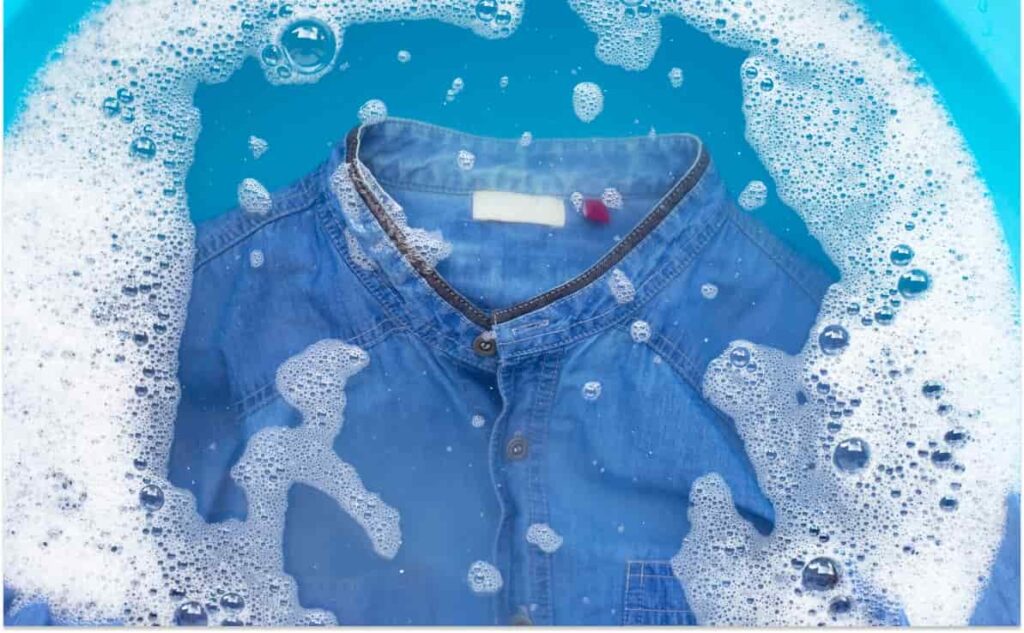
Bleach wash is a color stripping technique using strong chemicals to create light tones or mottled effects on denim. However, controlling the process to reduce bleach wash patchiness or color defects is a major challenge for every laundry factory.
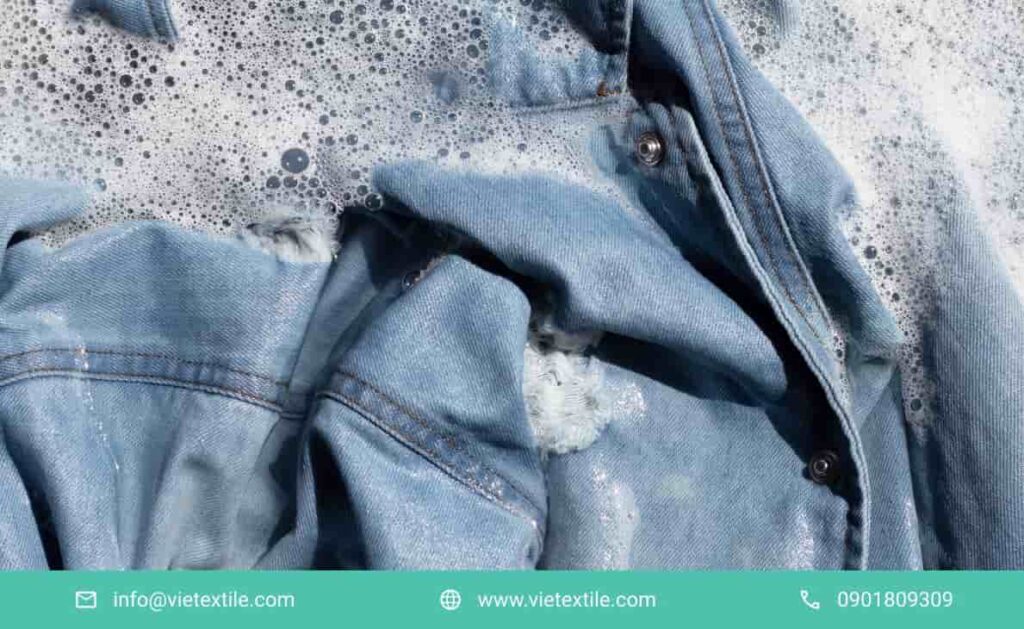
1. Understanding The Nature Of The Bleach Wash Process
Bleach wash is essentially a powerful oxidation reaction aimed at destroying Indigo dye molecules attached to the fabric fibers. The most common agent is Sodium Hypochlorite (Chlorine), a chemical with extremely strong bleaching properties that is difficult to control without a standardized process.
When Chlorine contacts the fabric, it not only removes color but also attacks the cotton fiber structure if the concentration is too high or the contact time is too long. Understanding this mechanism is the first step in a strategy to reduce bleach wash patchiness, helping technicians know exactly when to accelerate or inhibit the chemical reaction.
1.1. The Role Of Sodium Hypochlorite In Denim Bleaching
Sodium Hypochlorite works most effectively in a slightly alkaline environment. When introduced into the washing drum, Hypochlorite ions attack the double bonds in the dye molecules, causing them to lose their light-absorbing ability and become colorless or lighter in color.
However, the reaction rate of Chlorine is very fast and heavily influenced by temperature. If the water temperature rises too sharply and suddenly, Chlorine will act uncontrollably, causing localized color burning, which is the biggest barrier to reduce bleach wash patchiness on large batches.
1.2. The Difference Between Bleach Wash And Enzyme processing
Enzyme processing primarily uses biological action to soften and slightly fade the color, while bleach wash is a radical chemical color change. Bleach can take denim from dark blue to light blue or almost complete white, something that Enzyme processing alone can hardly achieve.
Due to this harsh nature, bleach wash is often performed after the Enzyme processing step to take advantage of the fabric surface already cleaned of fuzz. This combination allows the bleaching chemicals to penetrate the fiber core more evenly, significantly contributing to reduce bleach wash patchiness and creating color effects with more depth.
2. Causes Of Patchiness In The Bleaching Process
To find effective ways to reduce bleach wash patchiness, we must identify the “weak points” in the operating process. Patchiness does not only come from chemicals but also stems from the inconsistency of the water source and washing equipment.
Uneven coloration often appears as different dark and light patches on the same product or between products in the same wash batch. This often occurs when the bleaching chemical is not evenly dispersed or when the fabric overlaps, preventing contact with the bleaching solution.
2.1. Inconsistency Of Chemical Concentration
When a technician pours concentrated Chlorine directly into a rotating drum, the products contacted first will be bleached much more strongly than the rest. This is the most common cause of localized patchiness that many factories encounter.
The lack of dispersing agents also causes Chlorine to concentrate at certain points on the fabric instead of spreading evenly in the solution. To reduce bleach wash patchiness, diluting chemicals before introducing them into the machine and using penetration aids is mandatory.
2.1.1. Influence of the Liquor Ratio
A liquor ratio that is too low will cause the fabric to be tightly packed, creating “blind spots” that chemicals cannot reach. Meanwhile, a liquor ratio that is too high dilutes the Chlorine concentration excessively, causing the washing time to lengthen and damaging the fibers more.
2.1.2. Errors in manual measurement
Estimating Chlorine by eye or using inaccurate measuring tools leads to differences between wash batches. To reduce bleach wash patchiness professionally, factories need to apply automatic chemical dosing systems to ensure absolute accuracy.
2.2. pH Control – The Often Overlooked Factor
The pH of the bleaching solution directly determines the activity of Chlorine. If the pH drops too low (acidic environment), Chlorine will release toxic gas and react extremely violently, causing fabric damage and immediate patchiness. Conversely, a pH that is too high will slow down the reaction, wasting chemicals.
Maintaining a stable pH in the range of 10.0 – 11.0 is the golden key to reduce bleach wash patchiness. In this pH range, the bleaching reaction occurs steadily and controllably, helping the color to be stripped slowly and uniformly from the fibers.
2.2.1. “Hot spots” phenomenon due to pH fluctuations
In areas where there is residual chemical from previous steps (such as acidic Enzyme processing), the pH can decrease locally. This creates “hot spots” where Chlorine reacts faster than normal, leading to bleached white streaks on a blue fabric background.
2.2.2. Using Buffering agents
To maintain a stable alkaline environment, adding pH buffering agents to the process is an advanced technique to reduce bleach wash patchiness. These agents help neutralize minor chemical fluctuations in the drum, ensuring the bleaching effect occurs as intended from the beginning to the end of the cycle.
3. Effective Techniques To Reduce Bleach Wash Patchiness
After understanding the causes, we need to implement systematic solutions. To reduce bleach wash patchiness does not rely on a single step but is a coordination of many technical factors throughout the processing.
At VieTextile, we encourage customers to apply “Multi-stage Bleaching” and “Active Dispersion” processes. These techniques have helped many partners reduce the defect rate due to patchiness to below 2%, even with the most difficult ultra-light tones.
3.1. Chemical Dilution And Introduction Process
Instead of pouring Chlorine directly into the washing machine door, chemicals should be introduced through a secondary piping system pre-dissolved with clean water. The speed of introducing chemicals must be slow and steady, ideally divided into 2-3 pours throughout the bleaching cycle.
Rotating the drum continuously while introducing chemicals ensures every product has an equal opportunity to contact the same Chlorine concentration. This is a golden rule to reduce bleach wash patchiness that every machine operator must know by heart to avoid unfortunate errors.
3.1.1. Using a Side tank
Preparing the bleaching solution in a separate tank allows technicians to check the concentration and pH before officially starting the process. This approach eliminates chemical shocks to the denim fabric, helping the color fade more evenly.
3.1.2. Optimizing the drum rotation direction
The drum should be programmed to reverse direction continuously (e.g., 30 seconds left, 3 seconds rest, 30 seconds right). This helps flip the fabric constantly, eliminating fixed folds—which are places where chemicals easily accumulate and cause vertical streaks along the pant legs.
3.2. Controlling Washing Water Temperature
Temperature is the most powerful catalyst for bleach wash. The ideal temperature usually lies between 35-45 degrees Celsius. If the temperature exceeds 50 degrees Celsius, the ability to control color evenness decreases by 50% due to the excessively fast reaction rate.
To reduce bleach wash patchiness requires a stable and accurate heating system. The use of direct steam needs to be strictly controlled to avoid localized heating at the nozzle position, which easily causes the fabric to be over-bleached in a small area.
3.2.1. Sequential heating process
Fabric should not be exposed to hot water from the beginning along with Chlorine. Start at room temperature; after the chemicals have dispersed evenly, proceed to raise the temperature slowly. The gradual temperature increase helps the Indigo color to be stripped layer by layer, creating a smooth effect and helping to reduce bleach wash patchiness.
3.2.2. Rapid Cool-down after bleaching
As soon as the desired color is achieved, draining the hot water and replacing it with cold water immediately helps stop the chemical reaction. This cooling step keeps the tone “locked” precisely, preventing unintended further lightening after taking the product out of the machine.
4. Neutralization Technology – The Final Barrier To Reduce Patchiness
Many people mistakenly think that once the bleaching water is drained, the process is finished. In reality, Chlorine residue clinging to the fibers continues to act if not properly neutralized. This is the cause of fabric yellowing or patchiness after drying.
Using anti-chlorine agents (Antichlor) such as Sodium Metabisulfite or Hydrogen Peroxide is mandatory to terminate the bleaching reaction. Thorough neutralization helps protect fiber strength and ensures the long-term effectiveness to reduce bleach wash patchiness.
4.1. Using Sodium Metabisulfite
This is the most common neutralizing agent due to its high efficiency and low cost. It reacts extremely fast with residual Chlorine, turning them into non-toxic salts that are easily washed away in subsequent rinsing steps.
4.1.1. Dosage and neutralization time
The dosage of Sodium Metabisulfite is usually 1/2 to 1/1 of the amount of Chlorine used. The neutralization cycle should last at least 10-15 minutes to ensure chemicals penetrate deep into pockets and thick seams, where Chlorine is most easily trapped.
4.1.2. Chlorine test
After neutralization, technicians should use starch-iodide test paper to check if there is any residual Chlorine on the fabric. Ensuring the fabric is completely “Chlorine-free” is the final step in a sustainable strategy to reduce bleach wash patchiness before moving to the drying stage.
4.2. Applying Hydrogen Peroxide In High-End Neutralization
Hydrogen Peroxide (H2O2) not only neutralizes Chlorine but also helps the fabric surface look brighter and cleaner (brightening effect). This is the preferred solution for high-end denim lines that need pure whiteness in bleached areas without yellowing over time.
4.2.1. Eliminating “Yellowing” after drying
Residual Chlorine combined with high drying temperatures is the culprit behind mottled yellow stains. Hydrogen Peroxide helps completely destroy free radicals, protecting the original color and helping to reduce bleach wash patchiness by evening out the overall tone.
4.2.2. Protecting Spandex in stretch denim
Chlorine is very “hostile” to Spandex, causing them to rot and break. Rapid neutralization with H2O2 helps shorten the contact time of Spandex with Chlorine, ensuring stretch denim products still maintain their best form and elasticity after washing.
5. Alternatives To Chlorine Bleach To Reduce Patchiness
If efforts to reduce bleach wash patchiness using Chlorine are too difficult, businesses can consider alternative bleaching agents. Modern chemicals now provide higher safety and much more controllable patchiness effects.
At VieTextile, we often advise customers to use Potassium Permanganate or new-generation organic bleaching powders to gradually replace traditional Chlorine in fashion orders requiring delicate aesthetics.
5.1. Potassium Permanganate Bleaching (KMnO4 Wash)
Potassium Permanganate is often used for localized bleaching (such as whiskering effects) but can also be used for the entire garment. The advantage of KMnO4 is a stable reaction and easier neutralization than Chlorine, helping to reduce bleach wash patchiness effectively on sensitive fabric backgrounds.
5.1.1. Combining KMnO4 with Spraying techniques
Instead of dipping everything in the solution, spraying KMnO4 on predetermined positions allows complete control over the color areas to be bleached. Subsequently, the re-washing process in the machine will help these color patches blend naturally, minimizing unwanted mottling.
5.1.2. KMnO4 neutralization process using Sodium Metabisulfite
Just like Chlorine, KMnO4 needs to be neutralized to remove brown Manganese Dioxide stains. This neutralization step occurs spectacularly, immediately returning a bright and beautiful look to the denim fabric, making the process to reduce bleach wash patchiness cleaner and more professional.
5.2. Using Organic Oxidizing Bleaching Agents
Oxygen-based bleaches act slower than Chlorine but provide absolute color evenness. This is the optimal solution to reduce bleach wash patchiness for thin denim lines or Denim Knit.
5.2.1. High selectivity of organic bleaching powders
This chemical only attacks Indigo color while causing little damage to the Cellulose of the cotton fibers. This helps the fabric maintain its original weight, the surface does not become frayed after washing, and especially does not create sharp-edged patches.
5.2.2. Friendly to the environment and workers
Organic bleaching powders do not release toxic gases like Chlorine, significantly improving the working environment in the laundry workshop. At the same time, wastewater from this process is also easier to treat, helping businesses achieve sustainable production standards in the textile industry.
6. The Role Of VieTextile In Optimizing The Bleach Wash Process

VieTextile is not merely a fabric supplier; we are a partner accompanying customers in solving the most difficult technical problems. We understand that the ability to reduce bleach wash patchiness is a decisive factor for the profit and reputation of every denim batch.
6.1. Comprehensive Wash Process Consulting Service
We assist customers in establishing a Master Sample washing process before mass production. VieTextile’s team of experts will go directly to the factory to adjust machine parameters and chemicals to find the best plan to reduce bleach wash patchiness for each specific item.
The combination of our knowledge of fabric structure and your practical experience will create breakthrough Denim products. We provide detailed operating manuals, helping your technical team master the technology and confidently handle any situation arising during production.
6.2. Supplying Denim Fabrics With Stable Colorfastness
A good wash process starts from a good fabric base. VieTextile provides denim lines dyed with advanced technology, ensuring even distribution of Indigo color from the surface deep into the fiber core. This creates a very good premise to reduce bleach wash patchiness in subsequent steps.
Our fabric is strictly controlled for impurity concentration, helping bleaching chemicals penetrate evenly and react more stably. When using fabric from VieTextile, you will notice the process to reduce bleach wash patchiness becomes easier and results can be predicted more accurately than ever.
7. Frequently Asked Questions (FAQ) About Bleach Wash
7.1. Why is stretch denim more prone to patchiness than raw denim?
Stretch denim has a more complex fiber structure and contains Spandex—a substance that tends to absorb chemicals unevenly. Additionally, the shrinkage of stretch fibers in hot water changes the fabric density, making it harder to reduce bleach wash patchiness without using specialized penetrants.
7.2. Can patchiness defects be fixed after bleaching is finished?
If the patchiness is minor, you can perform a light Enzyme processing cycle to even out the tone. However, if it is too severe with white streaks, the only solution is to bleach the whole thing white or redye it a darker color to cover the defects.
7.3. How does water temperature affect fabric durability when bleaching?
The higher the temperature, the faster Chlorine destroys cellulose bonds. Bleaching at high temperatures not only makes it difficult to reduce bleach wash patchiness but also makes the fabric prone to tearing, rotting, or seam popping during use.
7.4. How to distinguish between chemical patchiness and fabric patchiness?
Chemical patchiness usually has random shapes, like spots or streaks. Fabric patchiness often follows the direction of the warp or consistent horizontal stripes throughout the length of the fabric. Identifying the correct cause helps you find the most appropriate way to reduce bleach wash patchiness.
For technical advice and the most optimal solution for your bleach wash process, contact VieTextile today!
Contact information:
Hotline: 0901 809 309
Email: info@vietextile.com
Website: https://vietextile.com